Tuesday, September 14, 2010

Harold Gould

 
Hollywood lost another great character actor when Harold Gould passed away this weekend, at the age of 86. Harold Gould had a career that spanned stage, screen and television. He was nominated for an Emmy for his portrayal of Louis B. Mayer in the NBC mini-series Moviola. Throughout his long career he received four additional Emmy nominations.

Most will remember Gould for his role as Martin Morgenstern, Rhoda's dad in the Mary Tyler Moore Show and it's spin-off Rhoda. He also had the re-occurring role of Miles Webber, Rose's (Betty White) boyfriend on The Golden Girls.

He was a television staple for the past fifty years, having guest starring roles on countless TV shows such as, Twilight Zone, Perry Mason, Empty Nest, The Streets of San Francisco, L.A. Law and Touched By An Angel. He originated the role of Howard Cunningham on the pilot for Happy Days, which aired as an episode of Love American Style.

His work in film included roles in Harper, Inside Daisy Clover, Patch Adams and Freaky Friday. But my two favorites are his roles in The Sting and in Woody Allen's Love And Death.


In The Sting he plays Kid Twist, a dapper con man, who works with Paul Newman and Robert Redford to pull off the con against Robert Shaw. In the con Twist plays the role of the Western Union operator who is supplying the names of winning horses to Henry Gondorff's (Newman) betting parlour. He cons Doyle Lonnegan (Shaw) into placing an incorrect bet and losing all his money.


Doyle Lonnegan: I put it all on Lucky Dan; half a million dollars to win. 
Kid Twist: To win? I said *place*! "Place it on Lucky D-" That horse is gonna run second! 
Doyle Lonnegan: [There is a pause, and Lonnegan runs horrified to the betting booth] There's been a mistake! Gimme my money back!


In Love and Death he plays a Anton Inbedkov a Russian noble who is involved with Countess Alexandrovna. When Boris Grushenko (Woody Allen) compromises her reputation Anton challenges him to a duel. Their bits of dialogue are some of the funniest in the film.

Anton: Grushenko? Isn't he the young coward all St. Petersburg is talking about? 
Boris: I'm not so young. I'm thirty-five. 

Anton: If you so much as come near the Countess, I'll see that you never   see the light of day again. 
Boris: If a man said that to me, I'd break his neck.
Anton: *I* am a man.
Boris: Well, I mean a much shorter man. 

Anton Inbedkov: Shall we say pistols at dawn? 
Boris Grushenko: Well, we can say it. I don't know what it means, but we   can say it.

Inbedkov: [preparing for duel] We'll do it now... and to the death.
Boris: Oh no, I can't do anything to the death. Doctor's orders. You see, I have this ulcer condition, and death is the worst thing for it. 

After Anton's bullet barely hits Boris and Boris refuses to shoot back Anton feels he is given a new lease on life and begins to sing about how he will devote himself to poetry and other beautiful things. Boris comments that he should have shot him after all.

From 1961 to 2010 Gould appeared in over 300 TV shows, 20 major motion pictures and over 100 stage productions. He is survived by his wife of 50 years, Lea and three children. RIP

*dialogue quotes come from IMDB.com

365+ movies in 365 Days: Day 136 - American Gangster


American Gangster is about capitalism at it's best. Frank Lucas (Denzel Washington) sees an under served customer base, goes directly to the source to buy his product cutting out the middle man. He delivers quality merchandise at a price lower than the competition, pays a good wage to keep his workers happy and invests his profits back into his business. Unfortunately, when your product is heroin, there are complications. The middle man you cut out is the Mafia and the cops on the take. Some of your distributors might not protect your brand name and dilute your product to increase their profits. It's difficult to line up new means to import your product, and the police are always on the lookout for you.

Set in the late 60's and early 70's American Gangster is based on the true story of how enforcer Frank Lucas for Harlem gangster Bumpy Johnson (Clarence Williams III) takes over as a crime boss in Harlem after Bumpy dies. He decides to stop using the Mafia as a supplier and flies to southeast Asia where he makes deals to buy heroin direct from the source, and use contacts in the U.S. military to smuggle the drugs via Army transport planes. He only partially dilutes the heroin and then puts it on the street at a lower price than the competition. Soon his product "Blue Magic" is all the rave and Frank is swimming in money. He uses that money to take care of his family and surround himself with lieutenants he can trust, his brothers.

Meanwhile Russell Crowe is an undercover detective Richard "Richie" Roberts on the Newark police force. He is putting himself through law school and struggling to keep his marriage afloat. When he and his partner find close to a million dollars during an investigation he turns it in, establishing himself as an honest cop, but ostracizing himself and his partner from every cop on the force. A guy that would turn in a million bucks is a guy that would turn in a dishonest cop.

His honesty works in his favor when he is put in charge of a federally funded task force to stop drug trafficking at it's source. He focuses his investigation on who ever is supplying Blue Magic, the heroin his ex- partner over dosed on. At one point in the film the question of capitalism comes up again, when Roberts questions if the authorities really want the drug trade stopped. If they did it would put an awful lot of people out of work, including himself.

It is inevitable that the paths of these two men will cross but Crowe and Washington do not share a scene until the last 20 minutes of the film. In order to balance the film director Ridley Scott, cuts back and forth between the growth of the heroin trade and the ongoing police investigation.

The movie is careful to contrast the lives of both men. Lucas, a criminal, has strong family values. He surrounds himself with family. He takes his mother to church every Sunday. He is a patron to the citizens of Harlem, just like his former boss was. He does not indulge in his product nor does he spend his money on flash and bling. He wears Brooks Bros. suits and keeps a low profile. Roberts is a womanizer and while he won't take a bribe, he lies and cheats on his wife constantly. He never makes time for his son, and the only thing he is good at, is being a cop.

Crowe and Washington do superb work and are surrounded by a great supporting cast. Ted Levine as Crowe's boss (he has come a long way since Silence Of The Lambs). Josh Brolin as an NYPD narcotics officer on the take, Ruby Dee, nominated for an Oscar, as Washington's mother, Armand Assante as a Mafia don, Cuba Gooding Jr. as a Harlem gangster and Chiwetel Ejiofor as Henry Lucas, Frank's brother and right hand man.

Filmed in NYC the movie captures the grittiness and urban decay of the city, circa 1970, just as films made in that time period did. It has the look and feel of films such as Serpico and The Seven-Ups.

It's a gripping drama and a great companion piece to The French Connection and Goodfellas. In fact watching all three in a row would make a great triple-feature.

At the Movie House rating ***1/2 stars

Monday, September 13, 2010

365+ movies in 365 Days: Day 135 - Invasion Of The Body Snatchers

Actor Kevin McCarthy passed away this weekend at the age of 96. He was a well known character actor and appeared in hundreds of movies, TV shows and stage productions. His film work included appearances in The Misfits, Mirage, The Best Man, Distinguished Gentleman and Innerspace. He was nominated for an Academy Award for Best Supporting Actor for his role in Death Of A Salesman in 1951.

He made appearances on some of the most popular TV shows including Twilight Zone, Columbo, The Fugitive, Hotel, Murder She Wrote, Matlock and Dynasty.

For years he toured the country in a one man stage show based on president Harry Truman called "Give 'em Hell, Harry".

But he will always be remembered for one of his few leading roles. Dr. Miles Bennell in the science fiction classic Invasion Of the Body Snatchers.


Released in 1956 the film was an early work of director Don Siegel who would go on to direct Hell Is For Heroes with Steve McQueen, The Killers with Lee Marvin and multiple films with Clint Eastwood including Dirty Harry and Escape From Alcatraz.

The movie was based on the novel The Body Snatchers by Jack Finney, which was originally published as a serialized novel in Collier's Magazine. The novel has been a popular source for inspiration in Hollywood. A direct remake of the 1956 film was made in 1978 and then two other adaptations, Body Snatchers (1993) and Invasion (2007).

The original is still considered the best and has appeared on numerous best films lists and has been preserved by the Library of Congress in the National Film Registry.


After it's release the film was viewed by many as an allegory against the invasion of communism. Other scholars and film critics saw it as an indictment of McCarthyism that was spreading across the country. The producer, director, screen writer, original author have all said there was no intention or discussion about connecting the film to prevailing political themes at the time. Those ideas have been imposed on the film after it's released.

In the movie Dr. Miles Bennell does discuss the dehumanization aspect of society and states that with the pods it happens all at once instead of people losing there humanity a little bit at a time.

It is one of the scariest movies of the 1950's and the thrills are achieved without giant monsters, spaceships and ray guns. Because of budget restraints the film has very few special effects and the terror is found in the paranoia of everyday things. What is dad doing in the cellar. Why is Uncle Ira looking at me that way while he mows the lawn. The terror builds slowly and culminates when we see the pod people growing in a greenhouse in Miles backyard. Then the film transition to a chase film as Miles and Becky Driscoll (Dana Wynter) attempt to get out of town and warn others about the pending invasion.

The film ends with the iconic moment of Bernell frantic, half-crazed, standing in traffic and yelling directly into the camera. "They're here already! you're next! You're next!"


I should say that is how the film originally ended. After viewing it, the studio insisted that the film have a more upbeat ending so a prologue and epilogue were added. In the beginning of the film we meet Dr. Bernell in a hospital. He is crazed and being held against his will. The doctor (Richard Deacon) thinks he is "as mad as a March hare". Another Doctor played by Whit Bissell agrees to listen to his story and then the narrative begins with a voice over by Kevin McCarthy, and the films main story is told in flashback. We return to the hospital when the story is finished. Both doctors are extremely skeptical until they are told of a truck accident on the highway where a driver was injured and these strange seed pods spilled out all over the road. Hearing this the doctor's and police jump into action to alert the authorities to stop the invasion. The film is left open if they succeed or not.


Political allegory or not the film is still a nightmare of paranoia and holds up well even by modern movie making standards. the running time is brief 80 minutes and the tension builds and builds and never lets up. The reduced budget forced the producer to keep things tight and also required him to cast a relatively unknown actor, Kevin McCarthy for the lead. Sometimes things work out for the best.


At The Movie House rating **** stars

Sunday, September 12, 2010

365+ movies in 365 Days: Day 134 - Vicky Cristina Barcelona


Is there another film maker who has excelled at capturing the complications of human relationships better than Woody Allen? He has written and directed almost forty films in the past forty years and everyone of them has something honest and funny to say about people, relationships and the nature of love.

Vicky Cristina Barcelona is his 4th film set in Europe. His first was Match Point, set in London, which was excellent and the other two are Scoop and Cassandra's Dream, which are on my must see list. As the title suggest Vicky Cristina Barcelona is set in Barcelona, Spain. Working in Europe has not only breathed new life into Allen's work, but it has also given great new cities to explore with his cameras. The movie is a travelogue of beautiful places in Barcelona, Gaudi and Oviedo.

The movie stars Rebecca Hall and Scarlett Johansson as two twenty-something American women who travel to Barcelona for summer vacation. Hall plays Vicky, a woman who knows exactly what she wants from life and has it all planned out. Johasson is spontaneous, adventurous and not sure of what she wants, but she'll know it when she finds it. What both women find is abstract artist Juan Antonio Gonzalo played by Javier Bardem. He sees them at an art gallery and then later approaches them with a straight forward proposition, fly with me to Oviedo, see the sights, have dinner and then make love to me. Vicky is insulted, but Cristina is intrigued and accepts. Vicky goes along to protect Cristina from herself. The relationships get complicated here. Even more so when Juan's ex-wife (Penelope Cruz), who tried to kill him, arrives and so does Doug (Chris Messina) Vicky's fiancee.

Rebecca Hall does a wonderful job of channeling Woody Allen, without the snappy one-liners and neurosis. Johansson is a delight as a woman open to new experiences, but unsure of what she wants. This was the third film she made with Allen. Penelope Cruz received a Best Supporting Actress Oscar for her role as the fiery, passionate Maria Elena. Javier Bardem manages to hold his own acting with these three women.

the film is not laugh out loud funny like some of Allen's other comedies. It's missing the quick wit and snappy, sarcastic one-liners that he would give the characters he played. It also has a certain level of melancholy about it, since everyone seems to be involved in relationships that don't satisfy them in some way. Like most of Allen's films about relationships there is no tidy ending where everyone lives happily ever after.

At The Movie House rating ***

Saturday, September 11, 2010

365+ movies in 365 Days: Day 133 - Office Space


Office Space has been on my "must watch" list for years. I had numerous friends and co-workers tell me I had to see this movie and now I understand why. They didn't want me to see it because it is the funniest movie ever made, because it's not, but it is one of the most authentic comedies ever made.

The other day my roommate mentioned that he had to develop an elevator speech. Do you know what an elevator speech is? I learned the term about two years ago. An elevator speech is a two minute spiel about yourself. The idea is to imagine yourself in an elevator with someone who would hire you. You have two minutes to say something that will have a huge impact. What will you say? That's an elevator speech. That is also the latest trend sweeping corporate America. Along with mission statements, smart goals, Bhags, the five 'whys" and all the other stuff that companies come up with instead of treating employees with respect and paying them a decent wage. All of that type of nonsense is captured in the film Office Space.

From the opening scene when Peter Gibbons (Ron Livingston) is stuck in traffic and every lane seems to be moving except the one he is in, I knew this movie would have some very ironic things to say about life in the work place. The film takes place at a company called Initech. Peter goes to work each day hating his job. Each day is worse than the one before, so every day is the worst day of his life. When the company brings in efficiency experts to downsize the staff peter comes up with a plan to take revenge. Something that is every office drones dream.

Gary Cole does a superb job playing the callous, superficial division vice president. It appears his only function is to make Peter's life miserable. Jennifer Aniston plays Peter's girlfriend. She works nearby in a chain restaurant and has troubles of her won because she does not wear enough flair.

The film was written and directed by Mike Judge, famous for the animated TV series and movie Beavis and Butthead. It's far from a perfect film. It begins as a scathing satire against corporate America and turns into a sort of farce with a rather abrupt ending. The script may not be fully realized, and not every joke hits the mark, but it sure feels Judge has spent some time in a cubicle himself.

At the Movie House *** stars

Friday, September 10, 2010

365+ movies in 365 Days: Day 132 - The Departed


As big a movie buff that I am, I don't get to see every movie I want to. I have a list of "must see" films and my goal in September is to shorten the list considerably. I am embarrassed to say that there are some very notable major films on the list, including five modern day (post 1960) Academy Award winners for Best Picture. The Departed was on that list and now I can cross it off.

I regret not seeing this film in a theatre. The level of tension in the film was palatable and I can only imagine how it felt sitting with hundreds of others, all at the edge of their seats, sometimes forgetting to breathe, as the complex narrative unwound. I had wondered if they gave Scorsese the Best Directing award as sort of a consolation prize for all the years he deserved it and didn't win, but The Departed is a true masterpiece to be listed amongst his other great films, Taxi Driver, Raging Bull, Goodfellas and Casino.

On the surface it is a cops and robbers film. The story follows two newly graduated Massachusetts State Troopers, Matt Damon as Colin Sullivan, a man who becomes a cop so he can be an informer to his mentor and crime boss, Frank Costello, played by Jack Nicholson, and Leonardo DiCaprio as state trooper William "Billy" Costigan, who becomes a cop to escape the criminal life of South Boston and then returns to it as an undercover detective. Costigan is in deep. His identity as a trooper as been expunged and he does jail time to increase his credibility. Only two men in the entire state police department, Captain Oliver Queenan (Martin Sheen) commander of the undercover unit and Sergeant Sean Dignam (Mark Wahlberg) his second in command, know his real identity to prevent him from being burned.

It is only a matter of time before Costigan realizes that Costello has someone in the special investigation unit keeping him informed, and Sullivan realizes Queenan has a cop in Costello's crew. Both men race to find the identity of the other before their own secret is revealed.

That's the plot of the movie, but it is about so much more. The movie handles complex themes of father-son relationships, self identity, catholic guilt, the lust for power and how it corrupts and growing up Irish in South Boston "you're either a cop or a criminal and when you have a gun pointed at your face, what does it matter?". All of these themes are woven into a rich, complex tapestry of moral ambiguity. And all of it is firmly planted in neighborhood and culture of South Boston. There are many American cities that this film could have taken place in, but some how Boston is the city where the story belongs.

The acting in this film is great. Damon is excellent as usual, and while I have not been a big fan of DiCaprio, I thought his work in this film was superb. DiCaprio and Damon must play two roles. The outer man they present to those around them, "the lie"and the inner man, who they really are, "the truth". The fact that the audience can see both men is a tribute to their acting ability. Wahlberg excels as an intense, dedicated cop and his few scenes are very memorable.

The entire cast is excellent with one exception, Jack Nicholson. There comes a point in a celebrity actors career when their own performances become a cliche of themselves. They become a parody of their own identity. This has happened to Robert DeNiro, Al Pacino, Robin Williams and Tom Cruise, to name a few. No matter what role they play certain gestures and expressions make the audience aware they are watching the celebrity and not a character.

Jack Nicholson has always had a few of these mannerisms, and they became even more pronounced after his over-the-top performance as The Joker, in 1989's Batman. In the past twenty years there are only two roles where I enjoyed seeing Nicholson completely submerge himself into a character, A Few Good Men and About Schmidt.

Watching The Departed there were many moments where the character of mobster Frank Costello was replaced with Jack Nicholson playing a mobster named Frank Costello. I had hoped that that Scorsese in directing Nicholson, would be able to contain his performance. Don't get me wrong, Nicholson was good, but this film pulls you in, layer by layer, until you are completely engaged and then Nicholson would say or do something that reminded me of the celebrity, not the character, and I would be taken out of the film for a moment.

The movie is a remake of a Japanese film called Internal Affairs. I have not seen it but it has been added to my list. This is the second time Scorsese has done a remake of another work. The first was Cape Fear. Here he succeeds in taking a Japanese story and turning it into a truly American saga.

At The Movie House rating ****

Thursday, September 9, 2010

New Cooking Blog

Hi Readers,
I have other interests besides movies and one of them is cooking. To see what I have been doing in the kitchen go to my new blog. Click on the above title "New Cooking Blog" and it will take you there.

www.mrjoeskitchen.blogspot.com

I look forward to your comments as I create delicious food in the kitchen.

Thanks,
Joe

365+ movies in 365 Days: Day 131 - Shutter Island


Today's movie was another film based on a Dennis Lehane novel, Shutter Island, directed by Marin Scorsese and starring Leonardo DiCaprio. The film is a mystery thriller about the disappearance of a criminaly insane mental patient and the U.S. Marshall sent to help find her.

When this movie came out I avoided all the press and buzz about it because I did not want to be surprised by a "spoiler" revelation. I knew that the film would have a twist and I wanted to go into the film not knowing what it was. I still remember watching The Sixth Sense and as the story unfolded have a sudden understanding of what was going on.

The movie takes place in 1954. DiCaprio is Edward "Teddy" Daniels a U.S. Marshall assigned to investigate an escaped mental hospital patient. The hospital is located on the site of an old civil war fort, on a remote island in Boston harbour. Everything about the island is foreboding, and as Teddy investigates he learns that there are secrets being kept on the island.

I liked Leonardo DiCaprio much better in this film than I did in Inception. He has the world weary look of a young man who went to war and came back old. He has seen things that no human being should see when his platoon liberated a concentration camp, and he carries what he saw in his eyes. He has none of the boyish swagger I find so annoying. He is supported by an outstanding cast that includes Ben Kingsley, Max Von Sydow, Mark Ruffalo, Michelle Williams, Ted Levine, Emily Mortimer, Patricia Clarkson, Jackie Earle Haley and John Carroll Lynch.

Scorsese directs with a firm hand and creates a palatable atmosphere of doom and despair. For the most part the CGI effects serve the film well, though there were a few times I realized what I was looking at was computer imaging and that ruined the film a bit for me. I also felt at a running time of 137 minutes the film was too long for a thriller and needed to be tightened up a bit.

Scorsese references many films, especially the works of Alfred Hitchcock, and like so many of Hitchcock's film if you want to know what the movie is about look in the shadows. But be careful of what you find there. You may not like it.

At The Movie House rating *** stars

Wednesday, September 8, 2010

Happy Birthday Star Trek


This blog is devoted to all things movie related, so today we say happy 44th birthday to the Star Trek TV series and the universe it created. On September 8, 1966 NBC aired the first episode of the original Star Trek TV series. The show would last just three seasons and produce 80 episodes, but it's impact on popular culture continues to this day. The series created a franchise that is worth over $4 billion dollars. There have been eleven feature films, five additional TV series, including an animated version, countless books and oodles of merchandise. Lines such as "Beam me up, Scotty" and "Live long and prosper" have become cultural catch phrases.

Here are the five captains of the Star Trek TV series.
Captain Kirk - Star Trek
Captain Picard - Star Trek: The Next Generation
Captain Janeway - Star Trek: Voyager
Captain Archer - Star Trek: Enterprise
Captain Sisko - Star Trek: Deep Space Nine


An illustration page from the animated TV series that aired
from 1973 to 1974


In 1979 paramount released Star Trek: The Motion Picture, it was a financial success but a critical bomb. Trekkies and non-Trekkies disliked it. A sequel was made in 1982, Star Trek II: The Wrath Of Khan, with more emphasis on action and less on talk and it was a huge hit. Many fans consider it to be the best of all the Star Trek movies. Star Trek II launched a story telling arc that would result in one of the best film trilogies ever made, with the story concluding in the phenomenally successful Star Trek IV: The Voyage Home.

The series was almost derailed after the critical and commercial failure of Star Trek V: The Final Frontier in 1989. This is considered the worst film in the series, directed by Captain Kirk himself, William Shatner. After an extra year's delay, Star Trek VI: The Undiscovered Country was released and put the series back on track. But the original cast was getting a little long in the tooth, so this would prove to be the final voyage of the full cast of the original Star trek series that had launched twenty five years earlier.

In 1994 a few members of the original crew appeared with members from the new TV series, Star Trek: The Next Generation, in a storyline that melded the two time periods together. It was successful and set the stage for the new crew to appear in a series of feature films.

The best of these was the 1996 film Star Trek: First Contact. It is one of the best films in the entire series. It featured time travel and the relentless and frightening Borg, and told the back story of earth's first contact with extra-terrestrial species. The next generation cast and crew went on to make two more films 1998's Star Trek: Insurrection and 2002 Star Trek: Nemesis. Nemesis was the least financially successful film of the series, and the next generation cast was now in their 15th year of playing these roles, so this film became their swan song.

In 2009 paramount Pictures "rebooted" the franchise by starting all over from the beginning. An entirely new cast was brought in to tell the adventures of the Starship Enterprise and it's five year mission to go where no man has gone before. To provide continuity Leonard Nimoy made his final appearance as Spock.

The movie was schedule for release on December 25, 2008. Paramount looked at the film and was so pleased by it's potential, they moved the date to May 2009 to establish a new summer blockbuster franchise. This gave director J.J. Abrams a few extra months to perfect the special effects. The delay proved to be a smart move for Paramount. The film was a massive box office hit. It won the hearts of skeptical Trekkies and appealed to regular audiences as well.

The journey continues on June 29, 2012 with the release of Star Trek 2 (aka Star Trek 12).

Here is a look back at the poster artwork from the film series.


The original poster from the 1979 film. Notice how it resembles other disaster movie posters of the time.

more graphic colorful poster

The 1982 sequel has a very 80's look.

a second poster still retains the 80's type logo but captures the artistic styling of the  1979 poster.

A teaser poster for the third film features a ghostly image of Spock

1984 poster in the same styling of the posters for the 79 & 82 films.

Teaser poster for 1986 film.

1986 poster references artistic style of earlier works but has a very 80's vibe, including the pastel colorings.  Modern day San Francisco is prominently featured.


80's pastels and style are still prominent in this poster from 1989


Like other posters, the teaser for Star Trek 6 did not feature cast members.


For Star Trek 6 the emphasis is on action. The poster is very dynamic.


The 1994 teaser poster for Generations. Like the other teaser posters none of the cast is shown. The graphic design mimics the shape of the Federation logo. At this point numbering the films was dropped.


This poster is almost identical to the teaser. Shatner and Stewart are prominently featured to link the old cast with the new cast.


The teaser poster for Star Trek 8 made it clear, The Borg were coming!


The theatrical poster for First Contact featured Picard, Data and The Borg


The poster Star Trek: Insurrection was the first not to feature any images of the cast.


The poster for Nemesis did not show the Enterprise, which had been featured prominently through out the series. Instead it had Picard, Data and a mystery figure in shadow and smoke.


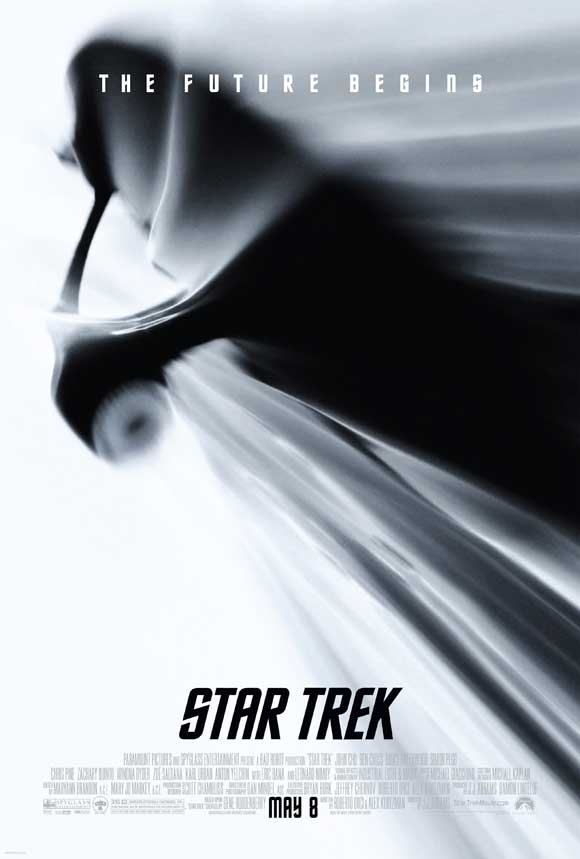
The original teaser poster for the Star Trek reboot. Note the film was scheduled for 2008


Another teaser from 2008 showing the Christmas release date.

The new teaser after the release was moved to summer 2009


An additional teaser poster for the 2009 reboot.


Closer to release date paramount published posters with the new cast and graphic elements hinting at the Federation logo.


Coming soon poster with cast.


Coming soon poster with emphasis on action.

Theatrical poster.


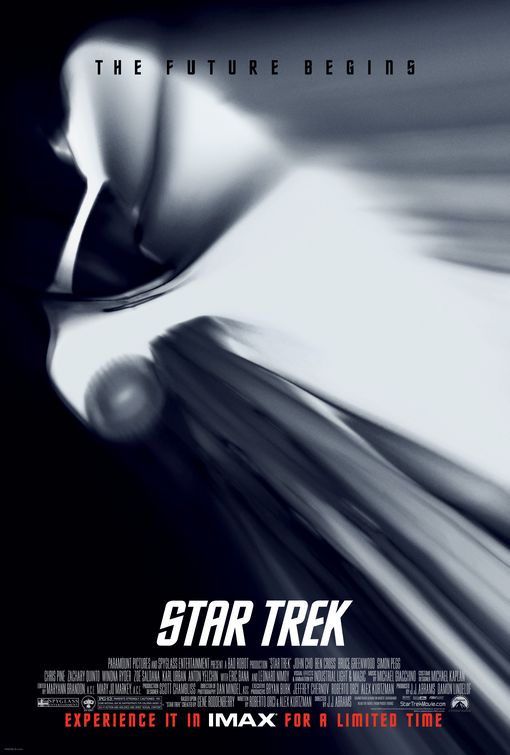
Reversed negative theatrical poster featuring IMAX

The Paramount marketing department produced over 20 posters for the reboot of the franchise.

So Happy Birthday Star Trek, may you live long and prosper!


365+ movies in 365 Days: Day 130 - Gone Baby Gone


Gone Baby Gone is a 2007 neo-noir thriller set in Boston, directed by Ben Affleck in his directorial debut and starring his brother, Casey Affleck. Casey is Patrick Kenzie, a neighborhood private investigator, who along with his girlfriend/assistant (Michelle Monoghan)  gets involved in a missing child case when he is hired by the girl's aunt (Amy Madigan), who feels the police are not doing enough. She feels Patrick is part of the fabric of the neighborhood and will be able to learn things the police cannot.

Kenzie learns the girls mother (Amy Ryan) who is is an alcoholic and a drug user, has lied to the police about the circumstances of the girl's disappearance.  In sharing this information with the police he becomes part of the official investigation and leads the police to the mom's boyfriend, who has been murdered.

There is a connection between the kidnapping of 4 year old Amanda, her mother, a drug dealer, the murdered boyfriend and some missing money. There are also deeper connections that are revealed as the story unfolds. There is another missing child, that may or may not be connected to the first. And there are unexplained questions in the investigation into Amanda's abduction.

The movie also stars Morgan Freeman, Ed Harris and John Ashton as the detectives investigating the case. All three are riveting to watch, but Amy Ryan as the coke addled mom steals every scene she is in. But the real star of the movie is the city of Boston, particularly the Dorchester neighborhood. Director Affleck goes out of his way to populate the film with authentic looking actors who look and feel like part of a close knit community. 

The film is based on the novel by Dennis Lehane, who also wrote Mystic River, another Boston based thriller about the nature of neighborhoods and friends.

I really enjoyed this film, I was pleased by the turn of events the story took, rather than thinking it was cop out. Casey Affleck has become an interesting actor to watch. If Ben Affleck's next film, The Town, opening in two weeks, is as good as this, he should give up acting and become a full time director.

At The Movie House rating ***1/2


Tuesday, September 7, 2010

365+ movies in 365 Days: Day 129 - Summer's End Film Festival: Gidget


My "Summer's End" film festival comes to a close with a screening of the 1959 hit film Gidget


Gidget introduced the surfing sub-culture to America. The movie has since been lost amongst the many "beach blanket" movies and TV shows that followed, but Gidget is the original and worth a look if you want to see another slice of American life that has disappeared in the sands of time.

Sandra Dee was at the height of her popularity when she made Gidget. Sandra plays Frances, a 17 year old girl that has not quite moved past the tomboy stage. When she goes to the beach with some friends, she does not want to date the surfers they see, she wants to surf with them. Pretty quick she has her own board and after some resistance the boys are giving her lessons. All the guys have nicknames; Moondoggie (James Darren), Hot Shot (Robert Ellis), Lover Boy (Tom Laughlin), Waikiki (Doug McLure) and Kahuna  (Cliff Robertson) and soon they nickname her "Gidget" short for girl and midget.

Gidget moves past her tomboy phase and develops a crush for Moondoggie and her troubles begin when she struggles to find a way to make him notice her. In the meantime her parents (Arthur O'Connell and Mary LaRoche) are trying to get her to settle down with a sensible and responsible boy.

The movie was shot in and around Malibu and Santa Monica using CinemaScope which adds to the surfing shots. The blue screen scenes of the three leads surfing are antiquated and kind of comical in a retro sort of way. After Gidget was released, the Southern California surf culture exploded into the American mainstream. From fashion to music, the surfing motif was everywhere. An entire sub-genre of surfing music, featuring bands like The Beach Boys, The Ventures and Jan and Dean became nationwide pop hits

The movie is simple, light hearted entertainment and represents an era that is long gone. But every teenager can relate to what's like to have a crush on someone and not be sure if they like you.


At The Movie House rating *** stars

Monday, September 6, 2010

365+ movies in 365 Days: Day 128 - Summer's End Film Festival: Summer of 42


The Summer of 42 is one of those films I have always meant to watch and never got around too. When I used my Tivo to search for "summer" movies I saw that it was playing on TCM last Saturday night. With a push of a button I set the Tivo to record and now I had my Sunday movie ready for watching.

The Summer Of 42 is a nostalgic tale of a boy's first love and is told in a narrative remembrance style.  The boy is Hermie (Gary Grimes) he is 15 and living on an island on Nantucket Island. It's summertime and he shares adventures with two buddies, Oscy (Jerry Houser) and Benjie (Oliver Conant). The boys spend their days walking the beach and thinking and talking about girls. Hermie is obsessed with one particular girl, a soldier's wife living in a remote beach house.

The movie tells the of the boys adventures learning about sex by taking a medical journal from Benjiie's house. Oscy teaches Hermie about condoms and convinces him to try to buy some from the local druggist. The boys double date some local girls where Oscy tries to go "all the way" but Hermie is barely interested in getting to first base, since his heart and mind is devoted to Dorothy (Jennifer O'Neill).

The film feels like it's being told by someone who remembers long ago events rather than from the boys point of view. Everything has an air of innocence and nostalgia about it. The scenes between Hermie and Dorothy are low key and lack intensity and then scenes in a drugstore and at the beach are the reverse, amped up for comic effect.

Aside from the fact that Dorothy's husband is a soldier and leaves to fight in the war, this coming of age story could have taken place any summer from 1942 to 1972. There is no reference to rationing, war bonds, or any other consequences of living during the war. In fact aside from the druggist and two brief glimpses of Dorothy's husband, there are no other adults in the movie. Even Hermie's mother is heard and not seen (voice work by Maureen Stapelton).

The film works because none of the actors are major stars. We are not distracted by seeing a familiar face playing one of the boys. If this movie had been made ten years later the studio would have required a star like Micheal J. Fox in the lead role.

Boys at that age will always be obsessed about sex, but I wonder how much times have changed the experience. In the movie the boys explorations are innocent and comical. What is it like for a teenager today? With a world obsessed with sex, the Internet a cornucopia of information and condoms handed out for free every where, I imagine the days of eagerly reading a medical manual for information are long gone.

It's interesting to note how times have changed for the film's subject matter. released in 1971 this film was both a critical and commercial hit without a hint of controversy. The Reader, a film that also dealt with an older woman and an adolescent boy having an affair, released in 2008, was met with criticism and cries of child abuse and child pornography.

At the Movie House rating ***

Sunday, September 5, 2010

365+ movies in 365 Days: Day 127 - Summer's End Film Festival: Dirty Dancing


Sometimes the movie business is completely unpredictable. There is no telling what type of movie the audience will respond to. Dirty Dancing is a low budget film, made with out any big name stars and released by a studio that had never released a film before. It was directed by a director who's only other film was a documentary and almost every one who saw it in pre-screenings thought it was terrible. Vestron, the studio that made it released the movie in late August 1987 expecting it to spend a weekend being seen by teens, it's target audience, and then go straight to home video.

Instead the movie became a worldwide phenomenon. The movie made $63 million dollars in it's initial release. Dirty dancing became a cultural touchstone for the '80s. It had a worldwide gross of $170 million dollars and the majority of tickets were sold to adults who admitted to seeing the movie more than once. It has been nicknamed "Star Wars for girls". The movie was the first film to sell over a million copies on home video. It had multi-platinum soundtrack albums, spawned a sequel and a stage musical adaptation bound for Broadway.

Why did this film strike such a chord with audiences, especially women? The secret is way director Emile Ardolino captured the chemistry between stars Patrick Swayze and Jennifer Grey. Their relationship on screen appears to be totally authentic. In addition they make the actual dancing look effortless, but still appear that they have to work at it. The odd mix of pop hits from the 60's and new music from 1987 seems to work. And the final dance seen, crackling with energy, leaves the audience feeling so good they forget any of the contrived moments that came before. Simply put the movie makes you feel good. You end up believing in the possibility of romance and idea that with a little practice you could dance like that.

At The Movie House rating **1/2 stars

Saturday, September 4, 2010

365+ movies in 365 Days: Day 126 - Summer's End Film Festival: Picnic


Picnic is another film that is best viewed as a type of time capsule. By today's standards it is an overwrought melodrama filled with unstated but ridiculously obvious sexual tension. The dialogue is overly dramatic and the film does not really work anymore. But if you view it in the context of the period it was made, than it can be seen with some merit for being a perfect "slice of life" view of small town America in 1955. You can admire the work of the supporting players, especially Arthur O'Connell and the way the film shows the relationships amongst the five key women, and the roles women played in mid 20th century America.

The movie is based on the hit play by William Inge and tells the story of a drifter who arrives in a small Kansas town on labor Day and disrupts the routine quiet lives of a small family.

The drifter is played by William Holden who is terribly miscast. He tries his best to portray a young man down on his luck a few years after getting out of college, but at 37 Holden was just too old for the part. This is a role that should have gone to a young Paul Newman or another star of that generation. But Columbia would not risk casting an unknown in such an important film. It is the first big starring role for Kim Novack  and she gives plenty of her longing looks and sighs, but she seems much too passive in the role.

The stars of the movie are Arthur O'Connell, who was also in the Broadway play, Rosalind Russell as an old maid school teacher and Susan Strasberg as Millie, a girl who has lived in the shadow of her older sister's beauty.

The overall problem with the film is the directing. Joshua Logan was primarily a theatre director and it shows in the way the film is shot. He directed the play on Broadway and it feels like he just transferred the Broadway show to film. The movie has it's moments, but it is slow and old-fashioned and easily dismissed by modern audiences.

At The Movie House rating **

Friday, September 3, 2010

365+ movies in 365 Days: Day 125 - Summer's End Film Festival: American Graffiti


By the time George Lucas made American Graffiti in 1972 the teenage experience of cars, cruising and rock and roll music was gone. The malls had replaced the downtown strip. The British Invasion had changed the face of music and the country, torn in two by the Vietnam war, had lost it's innocence. American Graffiti is a semi-autobiographical film about coming-of -age and loss of innocence for a group of teenagers and for America.  

The film follows four teenagers on the last night of summer. In the morning two of them are leaving for college and starting new chapters in their lives. For the other two, their lives will go on the same, but somehow different. The teenagers are represented by four archetypes: 

Steve Bolander (Ron Howard) - Class President, the popular and successful. Dates the most popular girl in school.
Curt Henderson (Richard Dreyfuss) - The smart guy. A fast brain and a quick wit. The class clown. Not as successful with the girls and always looking for the ideal girl.
Terry "the toad" Fields (Charles Martin Smith) - the class nerd. idolizes his friends and always dreaming of having the car and the girl. 
John Milner (Paul LeMat) The cool guy. The delinquent. And the boy who doesn't grow up. he is still living in his glory days of high school even though time is passing him by. 

The film follows their adventures over the course of a single night, cutting back and forth between them. Steve struggles with his relationship with his girlfriend Laurie. Curt chases an elusive mystery woman around town. Toad, cruising in Steve's car, finally gets the girl but is not sure what to do with her. And John gets tricked into cruising with a teenybopper and faces down yet another challenger to his title as "the fastest car in town". The stories intertwine and ultimately combine when the group comes together for a race on Paradise Road.

The film ends with photographs of the four boys and a notation of how their lives turned out. Two are dead. John in a car crash and Toad in Vietnam. Steve is an insurance salesman in Modesto, suggesting that his dreams and potential were never reached, and Curt is a writer in Canada, suggesting he is hiding out from the draft.

The movies bittersweet ending suggests the ending of America's period of idealism and innocence. These kids are the first of the baby boomers to reach maturity. They grew up in a decade of prosperity and promise. At the turn of the decade America held out hopes of a bright future and exciting new adventures.  Instead a year later the President was killed, and the country was plunged into a decade of strife and cultural civil war that still goes on today.

Many director's who grew up in the fifties have chosen to look back at this period. American Graffiti started a wave of nostalgic movies about life in mid-century America. The Wanderer's, Stand By Me, The Flamingo Kid, Cooley High, The Lords Of Flatbush and A Bronx Tale are just a few films that evoke a time when life seemed simpler on the surface, but underneath the same struggles existed.

You can't discuss American Graffiti without talking about the music. The movie does not have an underscore. Lucas used a soundtrack of rock and roll. The film has a non-stop string of pop hits from 1955 thru 1962. Everything from Buddy Holly to the Beach Boys. The music represents the origins of rock and roll in American. And dominating it all is the  omnipresent voice of Wolfman Jack. At one point a character mentions that rock and roll has never been the same since Buddy Holly died, not realizing that in just about a year the British Invasion of music would begin, changing rock and roll music for good.

The film was made on a shoe string budget with a cast of unknowns. The most well known star was Ron Howard. All of them went on to some measure of fame and fortune in Hollywood. Howard would act for a few more years and then become a successful director and Dreyfuss would play a variation on the character of Curt Henderson for the rest of his career. Harrison Ford had given up his idea of being an actor, and was working as a carpenter when Lucas cast him. The rest is history. The shortage of money forced Lucas to shoot the films in innovative ways giving the film a sense of realism that would not have been achieved in a studio with a bigger budget. The film was shot in and around the cities of San Rafael and Petaluma in Northern California. Mel's Drive-In was already a fixture in the area. The restaurant featured in the film had already closed by the time the movie was made. It was re-opened for the movie and then it was torn down afterwards.

The studios did not believe in the movie, and at one point Francis Ford Coppola offered to finance it himself, in order to ensure Lucas maintained creative control. But after sneak screenings in NY and LA the studio released the film with only four minor cuts and it was a commercial and critical hit. It made Lucas a wealthy man and allowed him to pursue his dream of making a space opera called Star Wars. When the film was released in 1978 Lucas restored the cuts to his original edit. The movie received five Academy Award nominations and between the two releases grossed $118 million dollars. Adjusted for inflation it is the 43rd highest grossing film in Hollywood history

At The Movie House rating ****

p.s. the poster art was by Mort Drucker who began his career as a popular cartoonist for Mad Magazine in 1956.

Thursday, September 2, 2010

365+ movies in 365 Days: Day 124 - Summer's End Film Festival:Stand By Me


Stand By Me is a summer's end coming-of-age story directed by Rob Reiner, based on a short story by Stephen King.

The movie tells the story of four boys, best friends, who spend the last weekend of summer together on a quest to find the dead body of a missing boy. Deep down the boys know this is the end of their friendship. The day after Labor Day they go into Junior High, where they will be separated by academic achievement.  As they go on this journey they explore the meaning and mystery of being 12 years old.

The movie features four authentic performances by the young boys, Wil Wheaton, River Phoenix, Corey Feldman and Jerry O'Connell. It's a tribute to Reiner that he was able to direct them so well. Prior to this Reiner was more well known for playing Archie Bunker's son-in-law on All In The Family. This movie demonstrated that he was a director to be taken seriously and he considers this film his favorite.

The title of the original Stephen King story was "The Body" and that is not a very good title for a coming of age adventure/drama film, so Reiner chose the name of the song Stand By Me, by Ben E. King, to serve as the movie's title. The song plays over the closing credits.

Music plays an important role in the film. The pop hits of the late '50's are continuously played throughout the film. I don't know if music has ever been more innocent and fun, then the early days of Rock and Roll.

The music also made me think of the songs that I remember from my childhood. I recall that I loved hearing Downtown and Georgy Girl on the jukebox at the Breezy Point Beach Club.  In the summer of 1972 when I was 12, there are two songs that I remember hearing over and over. The first was Don McLean's American Pie. My brother listened to this a lot and it played on the radio frequently. The other was a country hit called Delta Dawn. I would go on long drives all over Long island with my parents and they listened to WHN Country radio and Delta Dawn was a big hit for both Tanya Tucker back then.

At The Movie House rating ***

Wednesday, September 1, 2010

365+ movies in 365 Days: Day 123 - Summer's End Film Festival: A Midsummer Night's Sex Comedy


From 1975 to 1980 Woody Allen turned out a film a year. Two of the films created during this prolific period were his masterpieces Annie Hall and Manhattan. After the release of Stardust Memories, a sort of autobiographical rant against his fans and his own popularity he took a brief hiatus from movie making.
When he returned in 1982 with A Midsummer Night's Sex Comedy he demonstrated a more relaxed and mature style of films. This film marked the first time that Allen used an ensemble cast with him as just one part of a larger group. It also is the first of the thirteen films he would make with Mia Farrow.

The film is a cross between Shakespeare and Ingmar Bergman and while light in tone compared to his other films, still an enjoyable romp. The film drops the satire and sarcasm of his previous works and replaces it with a screwball comedy of manners.

The film takes place in the turn-of-the-century country home of Andrew (Woody Allen) and Adrian (Mary Steenburgen). Andrew works on wall street, but during the summer months he retreats to the country where he creates crack-pot inventions. Andrew and Adrian are deeply in love, but their marriage has been on the rocks for a few months. Leopold (Jose Ferrer) is Adrian's cousin. A pompous professor, he is engaged to be married to Ariel (Mia Farrow). Leopold and Ariel are driving out for a weekend in the country to meet cousin Adrian and get married at their country home. Dr. Maxwell (Tony Roberts) is Andrew's best friend and randy as a goat. He has a new woman with him every week. He is joining the party in the country and he brings his date, the lusty Dulcy (Julie Hagerty)

It turns out that Andrew knows Ariel and once lusted after her. Dr. Maxwell is instantly taken with Ariel  and wants her for himself. Meanwhile Leopold had his eye on the youthful and vigorous Dulcy. Ariel is torn between her fidelity to Leopold, her memories for Andrew and her attraction to Maxwell. Amongst all this Adrian has her own issues to work out. What ensues are thwarted seductions and mis-matched mates as group explore the meanings of love, sex, jealousy, romance and mysticism all on a beautiful summer day

It is not one of the best films Allen ever made, but it has enough of his signature one liners and situations to make it enjoyable. It also promises great things to come in this new ensemble style of film making.


At The Movie House rating ** 1/2